The appeal of this BMW M440 begins with a contrast that feels deliberate from every visible angle. Dark bodywork gives the convertible a composed, almost architectural presence, while Vesser Forged VSR1 wheels in Satin Silver introduce brightness exactly where the silhouette needs definition. The combination draws attention to the relationship between the body and the wheels rather than to a single isolated modification. With the roof open, the cabin becomes part of the exterior composition, adding another layer of colour and texture. The result has the atmosphere of a carefully considered grand touring car, expressed through stance, surface treatment and proportion.
The configuration is clearly defined: 20x8.5 wheels at the front and 20x9.5 at the rear. Both axles share a 20-inch diameter, while the rear wheels are one inch wider. This staggered arrangement is an essential part of the specification and an important distinction when describing the car. It gives the project a technical identity beyond the colour of the wheels. The dimensions establish the framework of the build, while the photographs show how that framework becomes a visual statement. On this BMW M440, the emphasis is on a confident wheel presence and a coherent relationship with the surrounding bodywork.
Seen from above, the convertible appears low and elongated, with the silver wheels marking the two ends of its profile. Their brightness makes them immediately readable against the dark panels and black tyres. The open roof allows the eye to follow an uninterrupted outline from the bonnet through the cabin and towards the rear deck. Within that outline, the wheels act as visual anchors. Their intricate faces prevent the lower half of the car from becoming a continuous dark mass. This balance between a restrained body colour and detailed wheels is central to the character of the entire presentation.
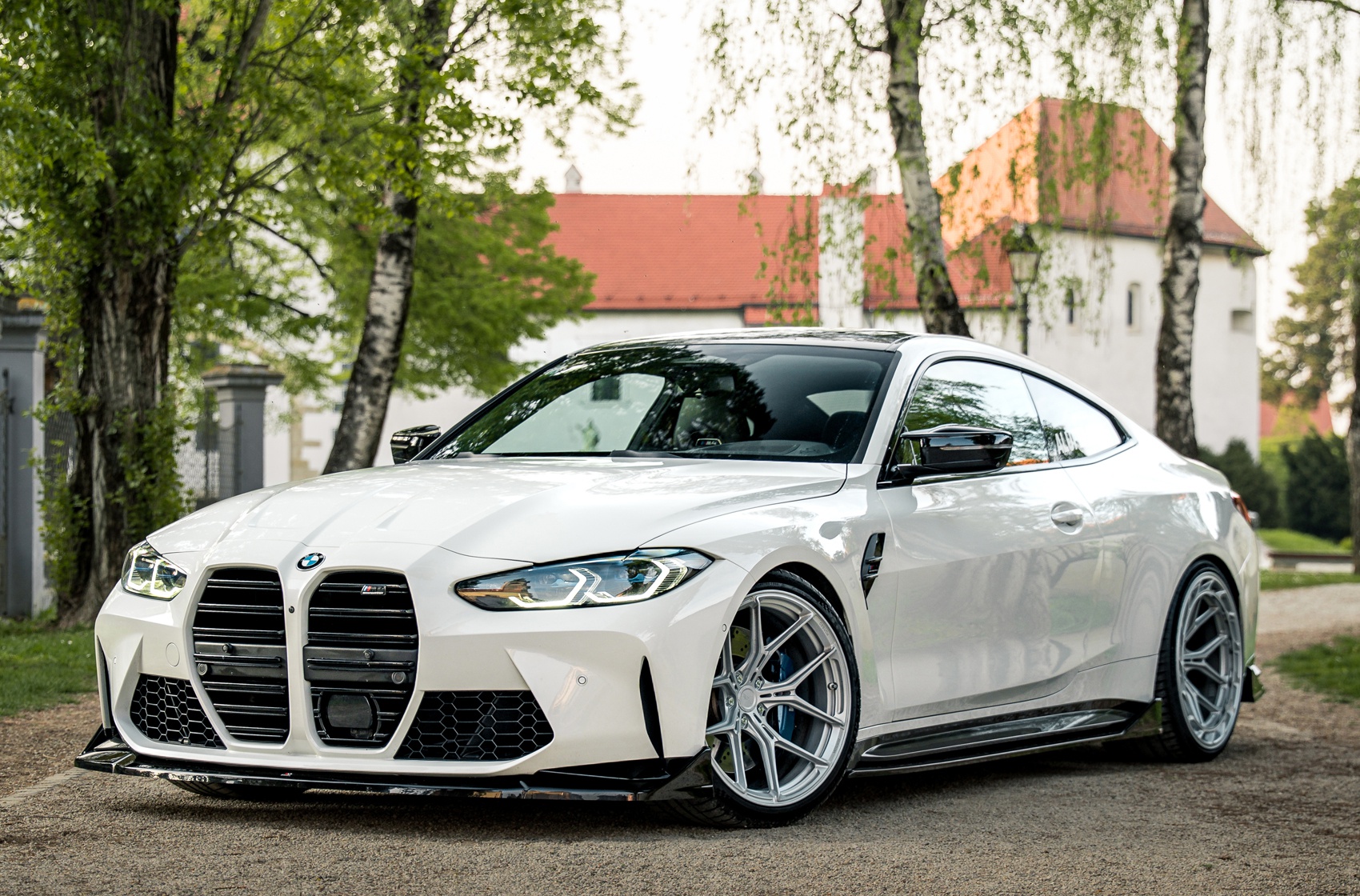
The VSR1 uses a mesh design, bringing a network of branching elements into the wheel face. In the closer photograph, those elements create a succession of narrow openings rather than a handful of large, simple gaps. The design feels technical because the eye follows several intersecting directions between the centre and the outer edge. There is a clear sense of movement within the pattern even when the car is stationary. Its complexity is organised around the hub, allowing the wheel to remain visually coherent rather than appearing busy for the sake of decoration. Satin Silver makes those relationships easy to appreciate.
Light is particularly important to the way this finish reads. The wheel faces remain bright in the sun, but their surfaces carry a softer appearance than an overtly mirrorlike treatment. Fine edges catch the light, while adjacent surfaces fall into gentle shade. This gives the mesh pattern definition without requiring a strong colour accent. Against the subdued bodywork, the finish creates a measured contrast that feels appropriate to the convertible setting. Satin Silver becomes a way of revealing the design itself: its branching structure, the relationship between openings and solid sections, and the transitions around the central area.
The photographs also demonstrate why wheel colour cannot be considered independently of the car. A silver wheel occupies the same position as a darker alternative, yet it changes how clearly that position is perceived. Here, the outer circumference remains distinct against the tyres, making the diameter visually prominent. At the same time, the spaces within the mesh preserve an open appearance. The effect combines presence with detail rather than relying on a broad, uninterrupted face. For a BMW M440 on 20-inch wheels, that distinction helps explain the character of the setup more accurately than simply describing the wheels as large.
From the lower front perspective, the VSR1 becomes a major part of the composition. The front wheel sits close to the camera, and its bright edges contrast with the dark front bumper, sill and wheel arch. The angle reveals the changing orientation of the surfaces across the wheel face, giving the mesh a sculptural quality. The rear wheel remains visible further down the body, repeating the same visual language on a smaller scale within the frame. This repetition connects the front and rear of the car, while perspective gives the photograph depth and makes the complete installation feel cohesive.
Concavity belongs to that three-dimensional reading, but it is best understood through the actual wheel geometry rather than an assumed label. The photographed faces show depth as their elements move between the central mounting area and the outer portion of the wheel. Shadows within the openings reinforce that impression. The available imagery supports a description of a sculpted, dimensional face; it does not establish a particular numbered concavity profile for this installation. The appeal is visible without assigning an unsupported specification. On the VSR1, the mesh structure and the variation in light across its surfaces provide enough detail to carry the description.
The staggered sizes add another layer to the composition. A shared diameter creates continuity, while the difference between the front and rear widths introduces a purposeful distinction between the axles. Width alone does not reveal the exact position of a wheel relative to a wing, and it should not be treated as proof of any particular offset. What the images do show is a visually substantial installation with the wheels strongly defining the lower body. The relationship appears considered within the photographed stance, giving the convertible a planted look without requiring claims about measurements that have not been published for the car.
Fitment is ultimately a relationship among several components. Wheel diameter and width are part of it, but tyre dimensions, offset, brake clearance and suspension geometry also matter. The confirmed 20x8.5 front and 20x9.5 rear specification therefore describes the featured wheel sizes, rather than a complete installation recipe for every BMW M440. That distinction preserves the value of the example. The gallery shows a finished aesthetic direction, while a separate vehicle-specific specification would determine how another installation is engineered. Visually, this car demonstrates how a mesh wheel and a restrained silver finish can work together within a dark convertible composition.
The close view adds a small but expressive colour detail: a blue brake caliper appears through the silver wheel structure. Its presence introduces contrast behind the face rather than on top of it. The openings allow that detail to become part of the image, with the darker space behind the wheel giving the silver elements greater definition. There is no need for a bold wheel colour when the surrounding components already contribute to the palette. The combination of dark bodywork, bright mesh and a visible blue accent gives the front quarter a layered appearance while maintaining a consistent overall mood.
Vesser Forged identifies the VSR1 as a forged wheel, with its product description emphasising strength and lightweight efficiency. That manufacturing identity gives the model a technical foundation alongside its visual design. In this feature, those qualities belong to the stated product concept rather than a measured comparison with the wheels previously fitted to the BMW. No published weight for this particular set accompanies the gallery. The appeal of the forged construction can therefore be discussed without inventing a kilogram figure or promising a quantified improvement in acceleration, braking or ride quality. The documented specification and the visible result remain the focus.
There is a useful connection between the idea of precision and the way the VSR1 looks. The repeated branches, carefully defined openings and clear transitions create an impression of controlled geometry. This is a visual assessment rather than a substitute for engineering data, but it helps explain why the wheel suits a premium automotive setting. The face offers more to discover as the viewing distance changes. From farther away, it reads as a bright, complex circle; closer up, its individual surfaces become apparent. That change in scale gives the design lasting interest within a photographic gallery devoted to the car.
The VSR1 range includes 19, 20, 21, 22 and 23-inch diameters. The featured BMW uses the 20-inch option, placing its configuration within a broader family rather than defining the entire model by one size. A wheel design can take on a different visual role as its diameter changes, because the relationship between the face, the tyre and the body changes with it. On this car, the selected diameter gives the mesh enough space to register clearly in both the wider architectural view and the closer front-quarter photograph. It establishes a strong presence without needing the largest diameter in the catalogue.
Satin Silver is also part of a wider finishing palette. The product page presents Satin Gunmetal, Satin Black, Satin Bronze and Gloss Black alongside the silver treatment shown here. Each changes the way the same mesh structure might relate to a body colour, although the photographed BMW has a particularly clear reason for its lighter finish. Silver separates the wheels from the dark paint and tyres, allowing the pattern to remain visible throughout the composition. The finish supports the design instead of obscuring it, making the VSR1 an immediately recognisable element of this particular configuration and its photographic identity.
The model is offered through ready-to-go and tailor-made options, giving personalisation a technical dimension as well as an aesthetic one. A bespoke wheel specification concerns how the wheel is configured for a particular vehicle, while a finish determines how its surfaces are perceived. Those two decisions work together but fulfil different roles. In the featured setup, the published dimensions and Satin Silver finish form the confirmed description. The gallery does not identify whether this particular set came through one production route or the other, so its finished appearance should not be used to infer an undocumented ordering specification or manufacturing arrangement.
The architectural location brings the character of the wheels into sharper focus. Brick, concrete and stone paving supply a backdrop with clear texture and strong lines. In the elevated photograph, a broad diagonal structure frames the car, while areas of sunlight and shadow divide the scene. The convertible occupies a relatively calm position within that larger geometry. The VSR1 wheels introduce a finer pattern inside it, echoing the sense of constructed detail without copying the surroundings. This setting makes the car feel grounded in a real urban space, with its materials and proportions interacting with the environment around it.
The lower image tells the same visual story at a different scale. Stone paving fills the foreground, the front bumper establishes the edge of the car, and the wheel becomes the most intricate object within that area. Bright spokes and dark openings create a rhythm that contrasts with the broader, quieter panels above them. The photograph also makes the tyre visible as a separate component, giving the wheel a defined border rather than letting it merge into the arch. These details explain why the combination works in a close crop as well as in an image showing the whole convertible.
An open cabin changes the balance of a wheel feature in a subtle way. With no roof spanning the passenger compartment, attention can move into the interior and then back out towards the body sides. The warmer upholstery visible in the elevated photograph adds a softer note to the otherwise cool exterior palette. Satin Silver sits comfortably between those elements: bright enough to contrast with the body, neutral enough to avoid competing with the cabin. The result has a lifestyle character rooted in the actual presentation of the car, rather than an imagined driving scene or an invented ownership story.
Luxury in this configuration is expressed through consistency. The wheel finish, dark panels, visible cabin and technical pattern all contribute to a composition with a clear hierarchy. The body establishes the shape, the wheels define the stance, and the smaller details reward closer inspection. There is room for an individual element to stand out without breaking the relationship among the parts. That is why the VSR1 does more than occupy the arches. Its design changes how the whole BMW is read, giving the lower silhouette clarity and supplying an intricate counterpoint to the smoother surfaces of the convertible body.
The performance character is similarly visual before it is numerical. The staggered dimensions, visible braking hardware and sculpted wheel faces give the car a purposeful atmosphere in the photographs. They do not establish a lap time or a measured handling change, and the feature does not need either to explain its appeal. A convincing automotive composition can communicate intent through proportion and detail. Here, the Vesser VSR1 brings that intent into focus with a pattern that feels engineered and a finish that keeps the engineering-inspired form visible. The result carries an assertive identity while retaining the elegance of the open-top setting.
There is also a sense of continuity between the close details and the wider view. The centre area, branching mesh and outer rim form a repeated structure at each corner of the car. Even when one wheel dominates the foreground, the others keep the same design language present elsewhere in the image. This consistency helps the modifications feel integrated into a complete vehicle rather than presented as separate objects. The BMW remains the subject, but the wheels determine how its proportions are emphasised. Their brightness and complexity guide attention through the car without requiring additional decorative elements to complete the effect.
Ultimately, the BMW M440 on Vesser Forged VSR1 Satin Silver wheels is defined by a specific combination of choices. The 20x8.5 front and 20x9.5 rear dimensions provide the staggered foundation, the mesh pattern supplies visual detail, and the silver finish creates a clear relationship with the dark body. The open cabin and architectural setting add context without distracting from that central idea. This is a premium wheel configuration whose appeal lies in how its elements work together: a confident stance, a dimensional face and a controlled contrast that gives the convertible a distinct, carefully resolved presence.