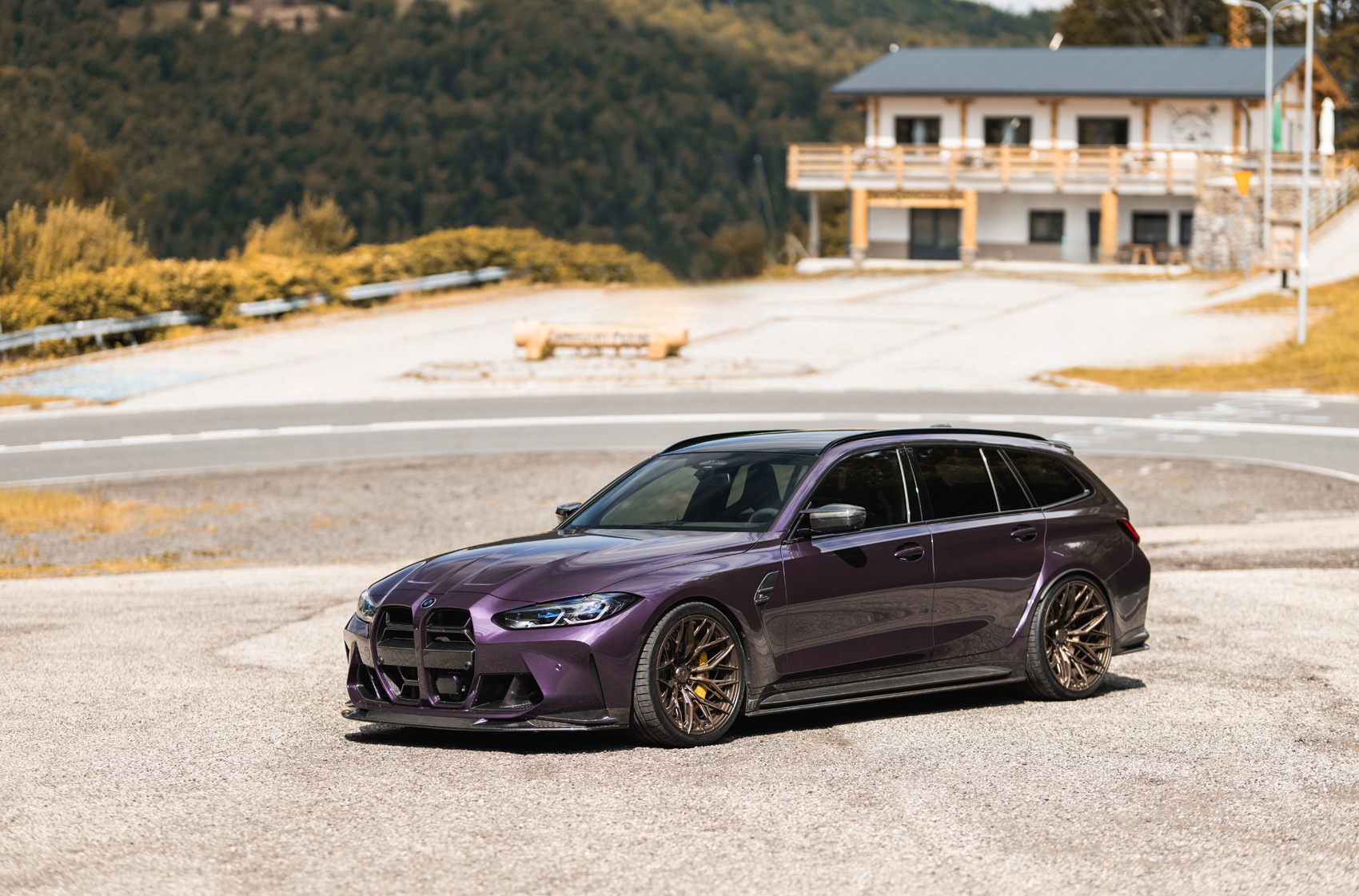
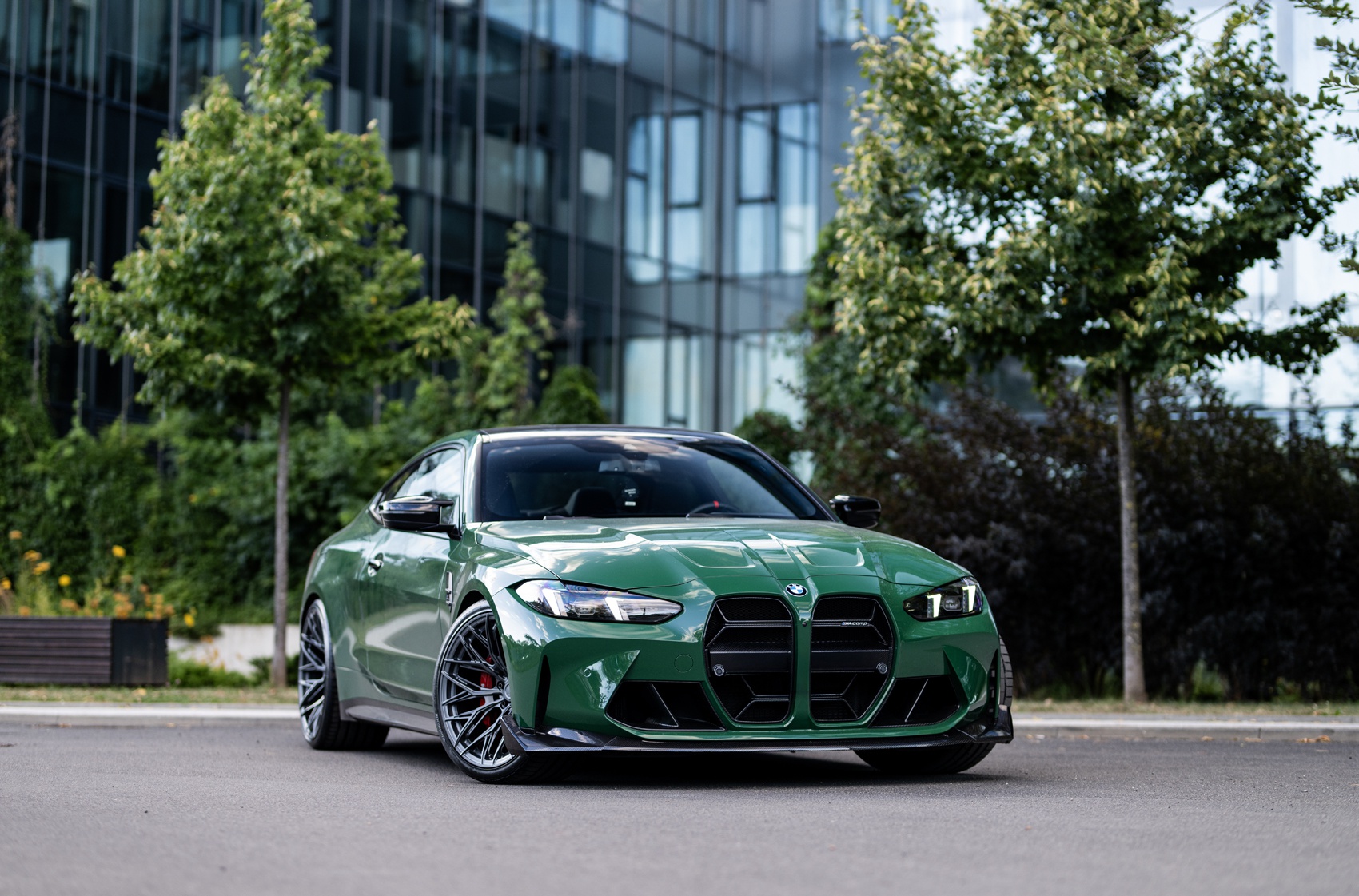
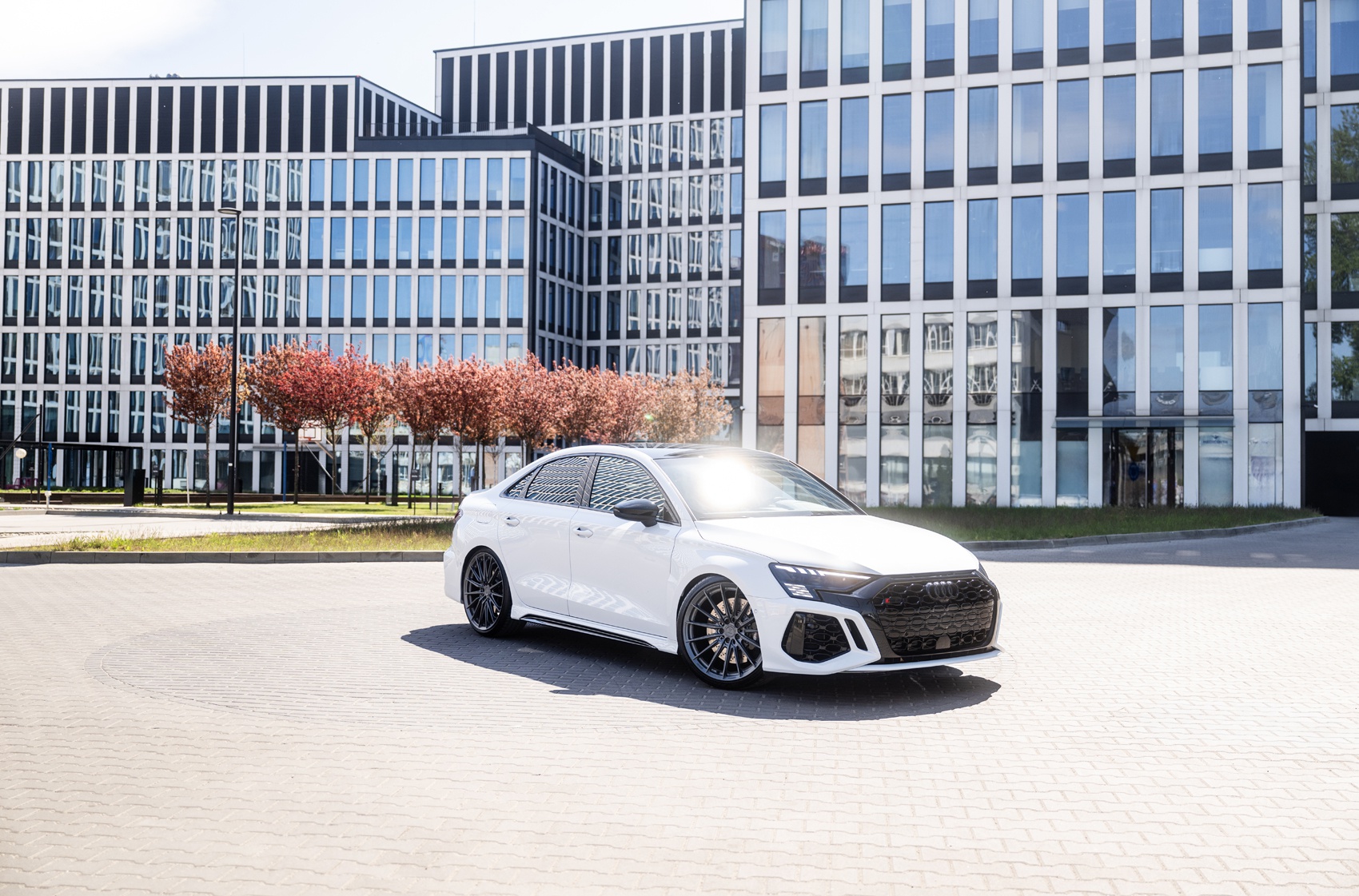
The BMW i7 already has the kind of road presence that makes traditional definitions of a luxury sedan feel almost outdated. Long, substantial and deliberately architectural, it combines the proportions of a flagship limousine with the clean surfaces and technical restraint expected from a modern electric car. In this configuration, however, the character changes noticeably. Fitted with Vesser VSR9 forged wheels in Gloss Black, the i7 becomes visually lower, more composed and considerably more individual. The wheel setup does not fight against the BMW’s sophisticated design. Instead, it gives the entire body a stronger foundation, drawing attention toward the lower half of the car and making its considerable length appear more purposeful. Against the graphite-grey bodywork seen in the gallery, the black wheels create a restrained monochromatic relationship that suits the i7 particularly well. Nothing feels decorative for the sake of decoration. The car simply looks more complete.
This particular BMW i7 runs a staggered 22-inch Vesser VSR9 setup, with 22x9 on the front axle and 22x10.5 at the rear. Those dimensions are central to the final appearance. A flagship sedan of this scale needs enough wheel to visually support its body, but diameter alone is not enough. Width, offset, concavity and the position of the wheel inside the arch determine whether a large wheel looks genuinely integrated or merely oversized. Here, the 22x9 front specification keeps the front axle clean and controlled, while the wider 22x10.5 rear creates more visual mass around the back of the car. Viewed directly from the side, the difference is subtle. From a rear three-quarter perspective, the additional width begins to reveal itself through a deeper face and stronger stance. The car feels planted without becoming exaggerated, which is exactly where a luxury build of this type should sit.
The Vesser VSR9 design was created around a dense, finely layered spoke arrangement. Rather than relying on a small number of heavy elements, the wheel uses a high-density pattern that radiates from the centre with an almost mechanical precision. There is a sense of rhythm to the design. The spokes repeat closely enough to create visual continuity, yet the machining and depth prevent the surface from becoming flat. From a distance, especially in Gloss Black, the VSR9 can initially appear almost monolithic. Moving closer reveals the complexity. Individual surfaces begin to separate, the spaces between the spokes become visible and the geometry around the centre gains considerably more definition. It is a wheel that rewards detailed photography because its appearance changes with viewing distance and light.
That effect works particularly well with the BMW i7. The car itself uses large, uninterrupted surfaces: long doors, a substantial shoulder line, an extended roof profile and relatively restrained side detailing. Placing an excessively simple wheel underneath that body could make the entire side view feel visually heavy. The VSR9 solves that problem through detail. Its tightly spaced architecture adds texture exactly where the body needs it, while the large 22-inch diameter prevents the intricate spoke pattern from appearing too delicate. The result sits somewhere between classic executive luxury wheels and contemporary performance wheels. It has the refinement expected from a flagship BMW, but enough technical detail to make the car feel modified rather than merely optioned.
Gloss Black plays an important role in that balance. On a bright Silver Machined Face version, every spoke of the VSR9 would be immediately visible and the wheel would become one of the first elements noticed on the car. Gloss Black takes the opposite approach. In shadow, the wheel becomes deeper and more discreet, visually connecting with the tyre and giving the BMW a solid, almost uninterrupted base. In direct sunlight, the gloss surface reflects highlights across the edges of the spokes, gradually revealing the layered structure underneath. The contrast between shadow and reflection makes the wheel feel more sculptural than a simple flat black finish. Against the grey paintwork, it creates a sophisticated separation without introducing another colour into the composition.
The setting visible in the gallery strengthens this effect. Modern architecture, dark vertical structures, glass and clean landscaping form an almost ideal background for the i7. The car shares the same visual language: long horizontal proportions, carefully controlled surfaces and technical details used with restraint. The wheels become part of that architecture. Their dense radial structure contrasts with the straight vertical lines of the building, while the Gloss Black surface links visually with the darker façade elements. In a profile shot, the entire composition becomes very graphic: a long grey body floating between two highly detailed black circles. It gives the BMW the atmosphere of a design object rather than simply another premium sedan.
There is substance behind the visual effect. Vesser manufactures its forged wheels from 6061-T6 aluminium, with engineering, machining, testing and finishing carried out in Poland. During the manufacturing process, the forged blank is formed under high pressure to create a dense material structure before being shaped on precision lathes and multi-axis CNC machining centres. The final geometry is then refined and finished before coating and quality control. The material and forged manufacturing method allow a strong strength-to-weight relationship compared with conventional cast-wheel construction, which is particularly relevant when creating large-diameter performance wheels.
This matters on a car such as the BMW i7. A large luxury EV places considerable demands on its wheels because of the size of the vehicle, its performance capability and the mass associated with the electric powertrain and battery structure. A 22-inch wheel therefore cannot simply be visually impressive; its engineering has to match the application. The current VSR9 READY-TO-GO programme lists a maximum load of 980 kg per wheel across the 21- and 22-inch specifications shown by Vesser. For the 22-inch range, Vesser currently offers configurations including 22x9, 22x9.5, 22x10, 22x10.5, 22x11 and 22x11.5 depending on the selected face and offset range. The 22x9 front and 22x10.5 rear combination used on this BMW therefore sits naturally within the technical character of the model rather than existing as an isolated show-car specification.
The broader VSR9 programme also allows the design to move beyond this particular setup. READY-TO-GO versions are currently offered in 21- and 22-inch diameters, while the TAILOR-MADE programme expands the range across 20, 21, 22 and 23 inches. Tailor-made widths extend from 20x8 through 20x12.5 in the 20-inch range, from 21x8.5 to 21x12.5, from 22x9 to 22x12.5 and up to 23x12 in the largest listed configurations. That range is important because proper custom wheels are not defined only by diameter. Width, offset, PCD, brake clearance and concavity all influence the final relationship between wheel and body. Vesser states that these parameters can be engineered around the exact vehicle geometry, allowing anything from a restrained OEM-plus stance to a considerably more aggressive show-car fitment.
On the i7, that philosophy becomes especially visible at the rear axle. The 10.5-inch width allows the VSR9 face to carry more depth than the narrower front wheel, subtly reinforcing the rear quarter of the BMW. It gives the car the visual behaviour normally associated with rear-biased performance sedans: controlled at the front, broader and more substantial toward the back. The difference does not need to be dramatic. In a well-executed staggered setup, a few carefully chosen millimetres can change the way the whole vehicle sits over its wheels. That is the essence of perfect fitment. The wheel should fill the arch without looking forced, follow the body rather than protrude unnecessarily, preserve brake and suspension clearance and create the impression that the body was designed around that exact wheel.
Concavity is another part of that equation. The VSR9 is not built around an exaggerated single-plane face. Its depth is created through the relationship between the centre, the layered spokes and the outer barrel. On wider applications, particularly at the rear, those transitions become more pronounced. The wheel appears to pull inward as the eye moves toward the hub, making the outer edge feel broader and giving the car additional visual track width. With Gloss Black, this effect is more subtle in low light and much more apparent when sunlight catches individual edges. That changing character is one of the reasons concave wheels remain so closely associated with high-end custom builds: the wheel does not look exactly the same from every angle.
The standard finish palette further changes the personality of the VSR9. Vesser currently presents Satin Gunmetal, Satin Black, Satin Bronze, Satin Silver, Gloss Black and Silver Machined Face for this model. Gloss Black, chosen for this BMW i7, is arguably the most discreet expression of the design. Satin Silver would expose more of the intricate geometry and create a brighter, classic premium appearance. Satin Gunmetal would sit closer to the body colour while still separating the wheel from the tyre. Satin Bronze would introduce a warmer, more individual contrast. Silver Machined Face would push the VSR9 toward a more formal executive aesthetic, while Satin Black would keep the dark character with less reflection than the Gloss Black configuration shown here. Vesser also offers tailor-made specification and finish possibilities beyond the core catalogue, allowing bespoke surface treatments, individual colours and project-specific brushed or polished directions where the final configuration requires a more personal character.
That degree of personalisation is particularly relevant in the premium segment because modern cars increasingly vary not only by model, but by brake package, suspension configuration and intended use. A set developed for a BMW does not necessarily need to share the exact geometry used on an Audi, Mercedes-Benz, Porsche or Tesla. The Vesser approach allows diameter, width, offset, bolt pattern, brake clearance, concavity and finish to be configured around the platform. This means the same VSR9 design language can work on a long-wheelbase luxury sedan, a powerful SUV or a more performance-focused application without forcing each car into one universal specification. Vesser describes its programme as suitable for luxury sedans, sports cars, SUVs and even supercar-level applications, with vehicle-specific fitment supported through in-house engineering.
The testing philosophy follows the same engineering-led approach. Vesser states that its designs are evaluated using Finite Element Analysis and verified through physical testing in compliance with standards including JWL, VIA and TÜV. At the same time, homologation is necessarily application-dependent: approval for a specific vehicle, wheel size, offset and market should be considered individually rather than assumed for every tailor-made specification. The Vesser website currently also maintains a dedicated TÜV certificate section, although the public certificate page is still being developed.
Seen as a complete package, the BMW i7 on Vesser VSR9 is a good example of why the best forged wheel builds are often the least theatrical. There is no need for an extreme colour combination, oversized bodywork or an aggressive visual theme. The impact comes from proportion. Twenty-two inches give the large BMW the scale it needs. The staggered 22x9 and 22x10.5 configuration establishes the correct stance. The dense VSR9 spoke design introduces precision into the lower part of the body, while Gloss Black keeps that complexity under control. Forged construction adds engineering credibility behind the appearance, and the ability to configure exact vehicle-specific dimensions turns the wheels from an accessory into an integrated part of the build.
The result is still unmistakably a BMW i7. Its luxury character remains intact, as does the clean, futuristic identity of the car. What changes is its attitude. On the factory silhouette, the i7 is formal, technological and imposing. On the Vesser VSR9 setup, those same qualities become darker and more deliberate. The car appears wider without needing visual excess, sportier without trying to imitate a track car and more exclusive without moving into show-car extravagance. It is a form of customisation that works through precision rather than noise: premium alloy wheels engineered around the car, a carefully controlled stance and the depth of forged construction visible every time light moves across the spokes.